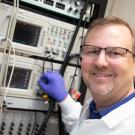
David Brockman, a retired CalFire captain and avid outdoorsman, built a deck in the backyard of his home last year, without the use of his dominant right hand, which he lost in an accident. The prosthetic hand he used instead was a crude but functional steel hook-and-harness device.
Brockman has tried other artificial limbs, including a high-tech prosthesis called a myoelectric. It looks like a hand and works by using electrical signals from muscles in the forearm. But that one just didn’t work for him.
The college is very pleased to welcome the newest members of its broad and diverse faculty. With appointments in the Departments of Evolution and Ecology, Plant Biology and Microbiology and Molecular Genetics, the new faculty are poised to make an impact on their respective areas of expertise, and on the classroom and laboratory experience of our students across the college.
Anya Brown
Assistant Professor Department of Evolution and Ecology
In Alzheimer’s disease and other neurodegenerative dementias, proteins that normally play a role in healthy brain tissue turn bad, clumping together to form insoluble plaques and tangles as neurons wither and die. Exactly how these proteins are connected to disease — and whether they can be targeted in some way to slow, stop or reverse its progression — remains a challenging problem.
This year’s graduate student awards emphasize the importance - and success - of mentoring younger scientists, and demonstrate the UC Davis commitment to collaboration, support and partnership that define interdisciplinary science. Graduate student awards support travel, research and professional development opportunities, and are made possible by generous philanthropic contributions to the college.
CBS Dean’s Mentorship Award
The Dean’s Mentorship Award recognizes graduate students who have demonstrated excellence in the mentorship of undergraduate students.
A new study shows how the brains of Egyptian fruit bats are highly specialized for echolocation and flight, with motor areas of the cerebral cortex that are dedicated to sonar production and wing control. The work by researchers at the University of California, Davis, and UC Berkeley was published May 25 in Current Biology.
Nine faculty from UC Davis are among 564 newly elected fellows of the American Association for the Advancement of Science, announced today (Jan. 26). AAAS fellows are scientists, engineers and innovators who have been recognized for their achievements across disciplines ranging from research, teaching and technology, to administration in academia, industry and government, to excellence in communicating and interpreting science to the public.
Here are the new fellows from CBS, listed with their AAAS commendations:
Wilsaan Joiner, an associate professor in neurobiology, physiology and behavior and Jonathon Schofield, an associate professor in mechanical and aerospace engineering, and colleagues, are working to develop better and more functional prosthetic devices for children.
For the 2021-2022 academic year, the college is proud to welcome three new members to its faculty. Below you’ll learn more about the research interest of each faculty member, and what brought them to UC Davis.
Xiaomo Chen
Xiaomo Chen joined the Department of Neurobiology, Physiology and Behavior as an assistant professor in September 2021. Before joining the UC Davis faculty, she was a postdoctoral fellow at Stanford University.
Last month, the University of California, Davis, officially launched a consortium called the UC Davis Neuroscience Consortium (UCDNC) to leverage the strength, breadth and depth of one of the largest neuroscience communities in the world. The consortium brings together nearly 300 researchers from eleven centers and 41 departments — integrating biologists, chemists, social scientists, engineers, computer scientists and clinicians.
Gerald Quon, an assistant professor in the Department of Molecular and Cellular Biology and the Genome Center, has received a New Innovator Award from the National Institutes of Health (NIH). The award will support the development of a computational framework for characterizing how genetic variants associated with the risk of psychiatric diseases like schizophrenia and bipolar disorder work at the at the cellular level.