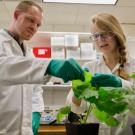
Growing up in Germany, Philipp Zerbe knew he wanted to be a biologist by the time he was 5 years old. In fact, he scribbled the decision to become a ‘Biologe’ down on paper, which his parents kept—and gifted to him upon becoming an assistant professor of plant biology in the College of Biological Sciences at UC Davis in 2014.
GradeR works simply. Instructors upload a Canvas grade book to the app, which then generates statistical and visual summaries of their grade book data, allowing them to track individual student and overall class progress.
Scientists have successfully sequenced the coast redwood and giant sequoia genomes, completing the first major milestone of a five-year project to develop the tools necessary to study these forests’ genomic diversity.
The genome—the complete suite of an organism’s DNA and genes—is likened to a blueprint for life. On the surface, this comparison provides some understanding of a biological concept. But according to some scientists, it misses the mark.
Assistant Professor Patrick Shih was recently selected as a 2019 Alfred P. Sloan Research Fellow in Computational and Evolutionary Molecular Biology. The fellowship will help fund his research to reconstruct the evolution of photosynthesis.
Plant biologists at UC Davis have discovered a way to make crop plants replicate through seeds as clones. The long-sought discovery could make it easier to propagate high-yielding, disease-resistant or climate-tolerant crops and make them available to the world’s farmers.
Associate Professor Siobhan Brady, Department of Plant Biology, was among the 19 researchers from UC Davis named in the annual Highly Cited Researchers 2018 list released by Clarivate Analytics.
In a new study appearing in Nature, Assistant Professor Nitzan Shabek and his colleagues add structural definition to the strigolactone signaling process in plants.
For her dedication to plant biology undergraduates, Associate Professor Siobhan Brady received the Outstanding Faculty Advisor Award from the Office of Undergraduate Education.
With robotics, computers and advanced genetics, researchers at the University of California, Davis, and Cold Spring Harbor Laboratory have established a core set of genes that help plants metabolize nitrogen, the key to plant growth and crop yield.