Mutations drive evolution, but they can also be risky. New research led by plant biologists at the University of California, Davis, published Nov. 10 in Proceedings of the National Academy of Sciences, reveals how plants control mutation rates in different stem cells to balance adaptability with safety and stability. The findings have implications for breeding some of the world’s most important fruit and vegetable crops, such as potatoes and bananas.
Although teaching is a core part of being a professor, most academics learn how to teach on the job. CBS’s Future Undergraduate Science Educators (FUSE) program is changing that.
How can plants adapt to their environment, and how will they be able to adapt to climate change? Those are among the biggest questions Johanna Schmitt has sought to answer during her career as a plant geneticist and evolutionary ecologist.
Faculty members in the College of Biological Sciences (CBS) and graduate student teaching assistants who support CBS undergraduates have been named Aggie Well-Being Champions. The new award recognizes instructors who prioritize students’ well-being and cultivate spaces where undergraduates can thrive.
Three faculty affiliated with the College of Biological Sciences are among the eight UC Davis faculty newly elected as fellows of the American Association for the Advancement of Science, announced March 27. They are: Frédéric Chédin, a professor and chair in the Department of Molecular and Cellular Biology; Dario Cantù, a professor in the Department of Viticulture and Enology; and Huaijun Zhou, a professor in the Department of Animal Science.
A battle around the world is raging between plants and the changing environment, and UC Davis researchers are on the front lines.
For example, the microbes are constantly creating new types of illnesses, while the plants — sometimes with the help of breeders — are developing new immunities.
It’s something plant geneticist Luca Comai, Ph.D. ’80, a distinguished professor of plant biology, has seen firsthand through his decades of research into plant chromosomes.
Each year, nearly 30 million Americans purchase a real tree for the holidays. Growing the perfect Christmas tree takes about seven years, during which farmers need to keep insects, fungal pathogens and hungry deer at bay. While researchers suspect the distinctive piney smell the trees emit plays a role in deterring these pests, not all trees smell the same, and which chemical blends confer resistance is unclear.
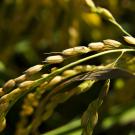
Rice is a staple food crop for more than half the world’s population, but most farmers don’t grow high-yielding varieties because the seeds are too expensive. Researchers from the University of California’s Davis and Berkeley campuses have identified a potential solution: activating two genes in rice egg cells that trigger their development into embryos without the need for fertilization, which would efficiently create high-yielding clonal strains of rice and other crops.
A flowering plant might not be able to tell how many fingers you’re holding up, but it can tell whether it’s light or dark outside and might grow differently if it suddenly finds itself in the shade of another plant.
Plants do that through photoreceptors, which are a major focus of research for John Clark Lagarias, a distinguished professor emeritus of molecular and cellular biology.
Photoreceptors have important uses, like measuring the length of the day; plants can tell when seasons change because the days get longer or shorter.
Sam Arcement—Director of Graduate Academic Programs for the College of Biological Sciences, and the program coordinator for the Molecular, Cellular, and Integrative Physiology (MCIP) Graduate Group—has been honored with the 2024 Outstanding Graduate Program Coordinator Award from the Office of Graduate Studies. This year saw a record number of nominations. “Sam tirelessly ensures that our needs and concerns are heard and addressed,” said one MCIP student, who praised Arcement’s dedication to student advocacy.