Even after being severely damaged by blast fishing and coral mining, coral reefs can be rehabilitated over large scales. In a new study, researchers installed 11,000 small, hexagonal structures called “spiders” across 5 acres of reef in the center of Indonesia’s Coral Triangle.
Ph.D. grad Allison Injaian studies the effects of traffic noise on tree swallows. In the fall, she'll continue her research at the Cornell University Lab of Ornithology.
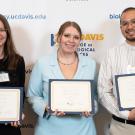
The David L. Weaver Award will provide financial support for neuroscience graduate students, postdoctoral scholars and/or junior faculty researching stroke and traumatic brain injury.
Seagrass carpets the seafloor creating a unique and vital ecosystem in shallow marine environments. Sea turtles graze on seagrass leaves while smaller organisms seek refuge in the green fields but, on the microscopic level, seagrass is also home to microbial communities. Such microbes compose the seagrass microbiome and potentially play a role in seagrass ecology.
Grace Ha is a Ph.D. candidate in marine ecology at UC Davis, where her thesis focuses on the analysis of camouflage in marine ecosystems. She is participating in the Leaders for the Future program, a five-month cross-campus collaboration between the Office of Research, the Career Center, GradPathways (Graduate Studies) and our institute. She recently participated in the Food, Ag + Health Entrepreneurship Academy as our 2018 Harkins Fellow.
Software inspired by speech recognition technology could help scientists understand the secret language inside cells. A machine learning algorithm called patteRNA, designed by UC Davis researchers, rapidly mines ribonucleic acid, commonly called RNA, for specific structures, providing a new method to establish links between structure, function and disease.