Research Stories

Chloroplasts Do More Than Photosynthesis; They’re Also a Key Player In Plant Immunity

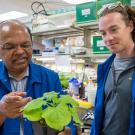
Scientists have long known that chloroplasts help plants turn the sun’s energy into food, but a new study, led by researchers in the Department of Plant Biology, shows that they’re also essential for plant immunity to viral and bacterial pathogens.

Chloroplasts are generally spherical, but a small percentage of them change their shape and send out tube-like projections called “stromules.” First observed over a century ago, the biological function of stromules has remained enigmatic.

Experiments in Yeast Hint at Possible Origins of Cancer and Autism

Cancer often starts with the reshuffling of DNA—akin to scrambling the pages of a dictionary. Exactly how this happens has long been a mystery. But researchers in the UC Davis College of Biological Sciences have now arrived at one promising explanation.

The problem seems to happen at a critical moment: when the cell is fixing a broken string of DNA. This repair process, called homologous recombination, can go awry, says Wolf-Dietrich Heyer, a Distinguished Professor and chair in the Department of Microbiology and Molecular Genetics.

NIH Awards Priya Shah $2.8 Million to Research How Zika Virus Causes Brain-Related Birth Defects

For most people, contracting Zika virus, a flavivirus carried by mosquitos, is akin to getting any mildly inconvenient virus. 

You might get a fever and a rash, and it's gone in a few days. But for pregnant people, there is a roughly 4% chance that a bite from a mosquito with Zika virus could have life-altering effects on developing fetuses in the form of microcephaly, a neurological condition that indicates an under-developed brain.  

Genome Study Shows Recent Spread of Eelgrass

Beds of eelgrass (Zostera marina) form an important habitat in coastal regions throughout the northern hemisphere, crucial to many fish and other species and storing vast amounts of carbon. A new study published July 20 in Nature Plants shows that eelgrass spread around the world much more recently than previously thought, just under a quarter-million years ago. The results have implications for how eelgrass could be affected by a changing climate.

Using Glowing Fish to Detect Harmful Pesticides

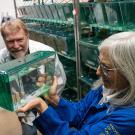
Birth defects related to chromosomal abnormalities often stem from exposure to chemicals early in the mother’s life. But determining which chemicals are at fault poses a serious challenge — akin to solving a hit-and-run case, decades after the fact. Two College of Biological Sciences researchers are developing a method that could identify harmful chemicals far more quickly, with the help of red- and green-glowing zebrafish.

Using Machine Learning to Detect Coronavirus Threats

An artificial intelligence model has successfully identified coronaviruses capable of infecting humans, out of the thousands of viruses that circulate in wild animals. The model, developed by a team of biologists, mathematicians and physicists at the University of California, Davis, could be used in surveillance for new pandemic threats. The work was published June 8 in Scientific Reports

An Engineering Approach to Solving Zika Virus 

Priya Shah, who holds appointments in the Departments of Microbiology and Molecular Genetics, and the Department of Chemical Engineering, is deciphering the behavior of the Zika virus on animal cells to delve into the possibilities for mitigating the sickness in humans.  

"My lab is really interested in how viruses hijack cells and turn them into little, tiny viral factories," said Shah.   

New UC Davis Research Using DNA Changes Origin of Human Species

In testing the genetic material of current populations in Africa and comparing against existing fossil evidence of early Homo sapiens populations there, researchers have uncovered a new model of human evolution — overturning previous beliefs that a single African population gave rise to all humans. The new research was published today, May 17, in the journal Nature.

Zoonomia Consortium Unveils Mammal Genomes, Creates Evolutionary Timeline

Mammals are an extraordinarily diverse and successful group of animals, from the tiniest pygmy shrew to the mighty blue whale, and including, of course, ourselves. In a special issue of the journal Science published today (April 27), the Zoonomia Consortium shows how comparing the genomes of 240 modern mammals sheds light on mammalian evolution, with implications for conservation and understanding human and animal health.